AI feed summaries
Design item, cluster, and briefing summaries with explicit fields for evidence, uncertainty, and source identity.
Build the workflowAI feed summary blueprints
Practical workflows for summarizing RSS, Atom, JSON Feed, news APIs, articles, PDFs, Markdown, and selected websites—with source identity, evidence, and editorial control intact.

Source coverage
A feed summary system works best when every source becomes a traceable record before a model writes anything.
Design item, cluster, and briefing summaries with explicit fields for evidence, uncertainty, and source identity.
Build the workflowParse real-world feeds, select the best content, preserve dates and GUIDs, and deduplicate before synthesis.
Read the RSS guideNormalize typed content, stable IDs, authors, links, and attachments into one format-neutral record.
Compare formatsTurn query results into clustered, novelty-ranked briefings instead of a repetitive stream of headlines.
Map the pipelineKeep page labels, headings, lists, tables, and block IDs visible as long documents become compact summaries.
Process documentsUse bounded scraping, change detection, verified tool calls, and human approval gates for automated monitoring.
Design an agentThe signal path
Every stage has one job and a visible handoff. That separation makes errors easier to find and summaries easier to trust.
See every workflowRetrieve approved feeds, API results, documents, or pages while preserving the original payload and retrieval metadata.
Map IDs, links, dates, authors, headings, paragraphs, tables, and attachments into a shared block model.
Remove exact duplicates, group related coverage, and retain differences instead of counting copies as consensus.
Use a versioned output contract for item records, topic synthesis, alerts, or executive briefings.
Check schema, evidence IDs, dates, quantities, entities, coverage, and review thresholds before publishing.
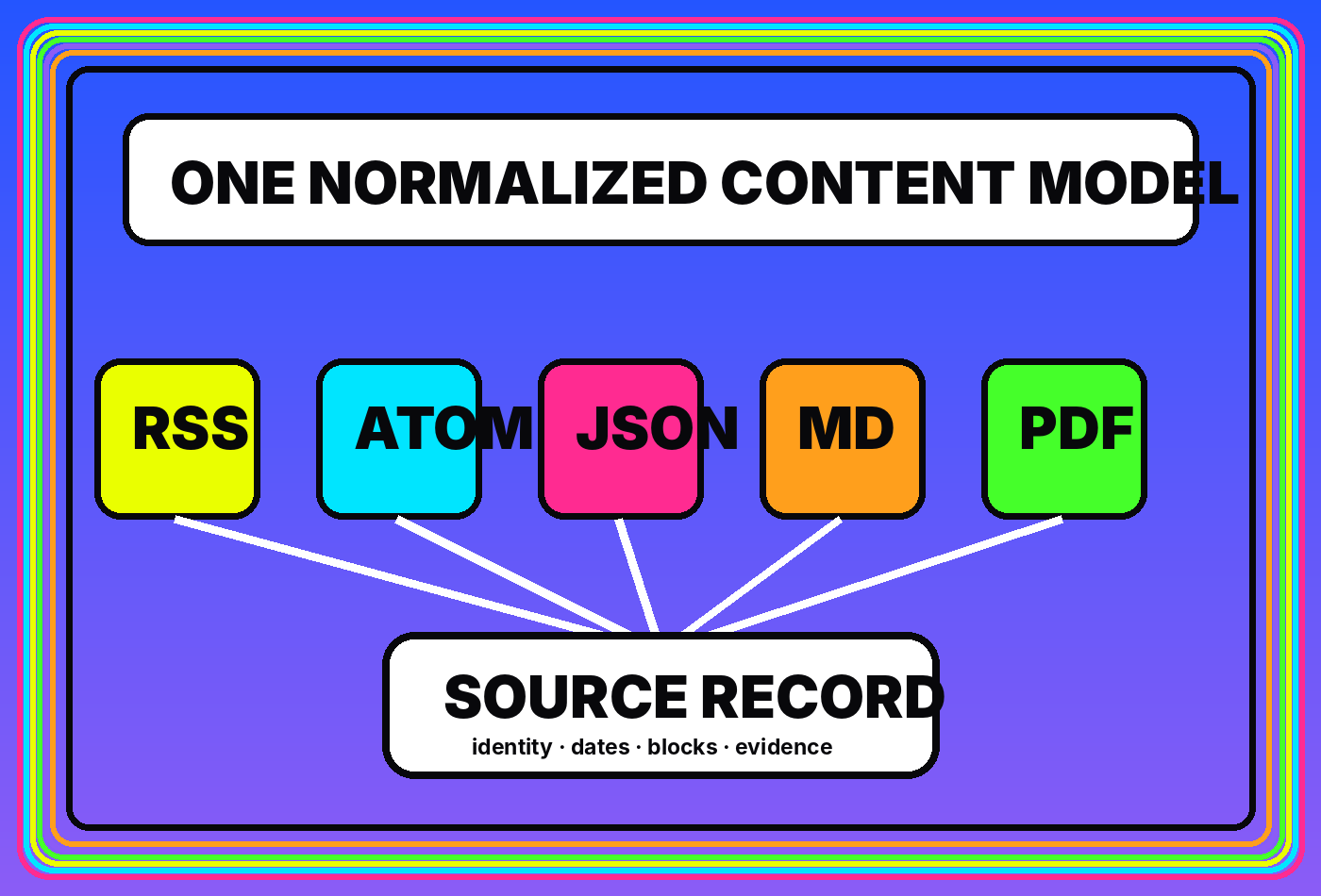
Format-neutral by design
Different source formats carry different strengths. Keep their original fields, then map them into a shared record with stable identity, dates, content blocks, and evidence locations.
A visible output contract
A summary can be concise without becoming opaque. Keep the input record, structured output, and evidence IDs connected.
Title: Product update adds export controls
Published: 2026-10-14 09:00 UTC
Coverage: Full article, 18 evidence blocks
Cluster: 3 related sources, 1 syndicated copy
Evidence: b04 · b07 · b11 · source FS-204
API-ready records
Stable fields make summaries renderable, searchable, testable, and portable across models. The API layer should expose extraction coverage, warnings, versions, and evidence—not only generated prose.
View API architecture{
"source_id": "rss-104",
"summary": "A neutral, evidence-linked briefing...",
"key_points": ["..."],
"evidence_ids": ["b04", "b11"],
"coverage": "full_text",
"status": "verified"
}Feed Signals
Long-form implementation guides for feed formats, document processing, prompts, scraping, and agentic news workflows.

An architecture for agentic AI news summaries that uses clear tool boundaries, event-driven updates, provenance, and human review gates.

Create prompt templates that keep feed summaries consistent across sources, models, topics, lengths, and editorial use cases.

A responsible website-scraping workflow for generating feed summaries from pages that do not publish usable RSS, Atom, or JSON feeds.
Frequently asked
Clear answers to common architecture and implementation questions.
An AI feed summary is a concise, structured representation of one or more feed items. A dependable workflow retains source IDs, dates, links, content coverage, and evidence locations so the summary can be checked.
Yes. Each format needs its own parser, but all can map into a shared internal record. The mapping should preserve raw fields and format-specific semantics instead of flattening everything into title and text.
PDF workflows must preserve page labels, reading order, tables, scans, and extraction method. Long documents usually need section-level records before a document-level synthesis.
Only within explicit policy. Retrieval, ranking, summarization, verification, human review, and publishing should be separate stages, with approval rules based on topic and destination risk.
This static site is an implementation-focused reference and design blueprint. It does not collect user data or provide an interactive summarization form.
Start with source records, choose a format-neutral schema, and use a prompt contract that keeps evidence and uncertainty visible.